Watch on YouTube
(Embed)
5,224
239
Genre: Autos & Vehicles
License: Standard YouTube license
Family friendly? Yes

Shared March 10, 2026
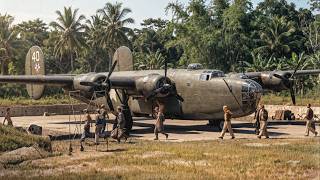
Discover the incredible archival footage of American airpower during World War II, featuring
the legendary B-17 Flying Fortress, B-25 Mitchell bombers fighting the elements in North Africa,
and the massive P-47 Thunderbolts gearing up for escort missions over Europe. This restored
historical film provides a unique glimpse into the daily operations, struggles, and triumphs of
the United States Army Air Forces in 1943. Witness the famous "Berlin Sleeper,
" a Boeing B-17 that survived over a hundred combat missions, showcasing the rugged durability of these
heavy bombers and the bravery of their crews. The video also captures the grueling ground
conditions faced by support crews in the Mediterranean theater, where torrential rains turned
operational airfields into thick mud, requiring sheer manpower and tractors to move aircraft like
the B-25 and C-47 cargo planes. Furthermore, watch as the formidable Republic P-47
Thunderbolts of the 8th Air Force are loaded with .50 caliber ammunition and fitted with
external drop tanks, essential for long-range bomber escort duties deep into enemy territory.
General Information About the Aircraft and Operations:
The air war in Europe and North Africa during WWII relied heavily on the logistical and
mechanical prowess of the unsung heroes on the ground. In North Africa, units like the 321stBombardment Group operated B-25 Mitchell medium bombers, constantly battling harsh
weather, extreme temperatures, and primitive airfield conditions. The ability to quickly relocate
and maintain these squadrons was crucial to the Allied advance across the Mediterranean and
into Italy. Mud, rain, and dust were constant enemies of the complex Wright R-2600 Twin
Cyclone radial engines powering the Mitchells. Ground crews often worked entirely outdoors,
using whatever tools and vehicles they could scavenge to free bogged-down multi-ton aircraft.
Meanwhile, in England, the 8th Air Force was tasked with a relentless daylight strategic
bombing campaign aimed at dismantling the enemy's industrial and military infrastructure. The
Boeing B-17 Flying Fortress became the symbol of this effort. However, unescorted heavy
bombers suffered unsustainable losses against determined enemy fighter interceptors. The
introduction of the Republic P-47 Thunderbolt provided the B-17 and B-24 bombers with the
necessary fighter escort to survive the heavily defended skies over occupied Europe.
The P-47, affectionately known as the " Jug" due to its milk-jug-like profile, was heavily armed
with eight .50 caliber Browning M2 machine guns and was incredibly rugged, capable of
bringing its pilots home despite severe battle damage. Powered by a massive Pratt & Whitney
R-2800 Double Wasp engine, it was the heaviest single-engine fighter of the war. The utilization
of auxiliary fuel tanks (drop tanks) was a monumental game-changer, allowing these powerful
fighters to stay with the bomber streams much deeper into hostile airspace, successfully
fending off interceptors and ensuring the bombers reached their targets.
#WWII #AviationHistory #USAAF
The Blueprint Vault and 4 more
9.8K views


1M views
16K views

8.1K views
British WW2 Files and 2 more
2.6K views

223K views